 Holocaust Remembrance

Joseph Schönberger
Mayer Schönberger, born in 1884 in Porúbka Czechoslovakia, built his wealth through a soap factory and a bus company, complete with warehouses for maintenance and storage. The family were also farmers, owning extensive agricultural land across the Michalovce region—including the towns Úbrež, Jovsa, Jastrabie pri Michalovciach, Porúbka, Čečehov, and surrounding areas. Every Jewish holiday, Mayer gifted his wife Fany (née Schwartz, born 1886) exquisite jewelry, a testament to their comfortable life. Their youngest son, Joseph Schönberger, born September 16, 1917, grew up amid this stability, pursuing chemistry studies and serving as a navigator in a Czechoslovak Air Force bomber squadron—skills that would later save his life.
The family's world collapsed with the rise of Nazi-aligned Slovakia. After the country declared independence as a puppet state on March 14, 1939, anti-Jewish laws intensified rapidly. In April 1939, quotas restricted Jewish professionals, and by year's end, Jewish soldiers were dismissed from the military. Joseph, stripped of his rank because he was Jewish, returned home to Úbrež just as the deportations began.
The horrors escalated in 1942. Slovakia became the first Axis ally to deport its Jews en masse, paying the Nazis 500 Reichsmarks per person. On March 25, 1942, the first official transport of 999 young women left Poprad, Czechoslovakia for Auschwitz. Among them was Joseph's sister Helen (born April 13, 1924), whose ordeal is chronicled in the book 999: The Extraordinary Young Women of the First Official Jewish Transport to Auschwitz (link to documentary movie trailer). Subjected to brutal medical experiments, Helen was rendered infertile by the Nazis—yet years later, thanks to advanced American medicine, she was able to have twin boys.
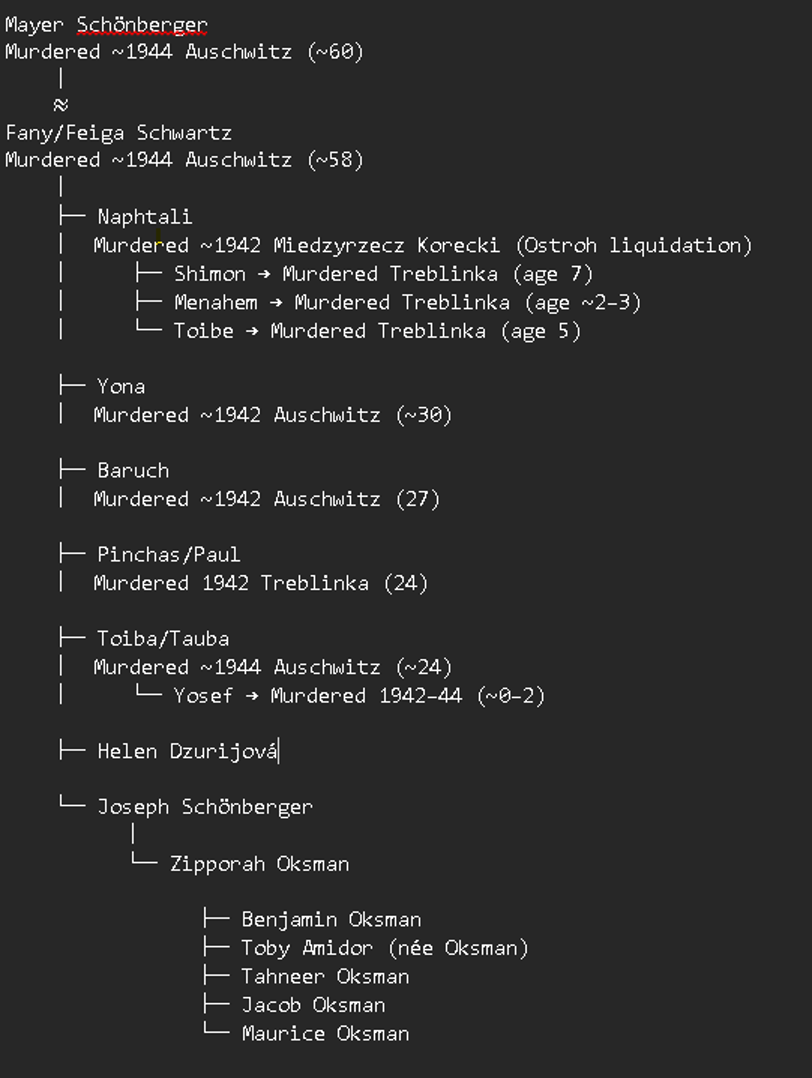
Joseph's brothers and their families were taken one by one: Naphtali (born 1904, murdered in Miedzyrzecz Korecki during the Ostroh ghetto liquidation in October 1942), Yona (1912, Auschwitz 1942), Baruch (1915, Auschwitz 1942), Pinchas (1918, deported April 1942, murdered in Treblinka), and Toiba (1920, Auschwitz 1944), along with their children—Shimon (1935), Menahem (1940), Toibe (1937), and Yosef (1942)—most of whom perished in Treblinka or Auschwitz. Mayer and Fany were murdered in Auschwitz around 1944. Only Joseph and Helen survived as direct family members.
As the deportations swept through Úbrež in 1942, Joseph hid in one of the family's former bus warehouses, crawling into a maintenance shaft beneath the vehicles. For months, a mysterious local hero—perhaps a non-Jewish worker or neighbor—risked execution to secretly bring him food. When the aid suddenly stopped, Joseph grew emaciated, his teeth falling out from starvation. Desperate, he fled into the forests around 1944, as the Slovak National Uprising erupted on August 29.
In the forest, Joseph encountered Russian partisans, who were often reluctant to include Jews due to widespread antisemitism. But he had valuable intelligence: from his hiding place, he had observed German forces storing equipment in the repurposed family warehouses. Offering this knowledge, he earned a place among the fighters. Though weakened and barely able to hold more than one grenade, Joseph led raids and fought in guerrilla battles against Wehrmacht units, sabotaging supply lines during the uprising's fierce clashes. The revolt was crushed by October 1944, but surviving partisans continued operations until the Red Army liberated the region in April 1945.
One memory Joseph shared with his daughter, Tzipporah Oksman (Talia’s grandmother), was that despite coming from an Orthodox kosher home growing up, he ate horsemeat with the Russian partisans to survive while in the forest.
After the war, Joseph emerged as a displaced survivor. In 1945–1948, he joined the exodus of Jewish refugees fleeing Europe, sailing to Israel. In the newly established State of Israel, Joseph settled in Ashkelon, where he met Hannah Shoenberger, a Romanian survivor who had endured her own ordeal hiding in her family's attic. Their marriage provided mutual security amid shared trauma, and together they rebuilt their lives.
Joseph later reconnected with his sister Helen, who had miraculously survived Auschwitz, emigrated to the United States.
Joseph Schönberger went to shul twice every day, in the morning and evening, to say mourner’s kaddish for all of the family he lost in the Holocaust. He died on May 18, 2009, in New Rochelle, New York, leaving behind a legacy of unbreakable resilience—from air force navigator to partisan warrior and Israeli pioneer.
Modern AI-driven research has now uncovered over 200 parcels of land scattered throughout the Michalovce region, reviving the family's once-vast agricultural holdings that were seized during the Holocaust and subsequent communist nationalization. These discoveries, rooted in pre-war ownership records, inheritance certificates from 1948 and 2004, and cadastral extracts, highlight the scale of the family's lost fortune and underscore the enduring quest for justice and restitution for Holocaust heirs. Joseph's story, intertwined with this reclaimed legacy, stands as a powerful testament to survival and the unbreakable bonds of family across generations.
Schonberger Family Tree and Location of Murders of Family Members:
Rachel Michaelson
Rachel Michaelson (later Oksman) was born in 1923 in the turbulent years of early Soviet Belarus. Her family, like many Jewish families in the region around Gomel, faced the harsh realities of the time. In the late 1920s and early 1930s, as the Soviet government pushed aggressive collectivization of agriculture, many Jews from urban shtetls and towns were encouraged—or in some cases effectively compelled—to relocate to collective farms (kolkhozes). These were part of a broader effort to transform "non-productive" urban Jews into agricultural workers, often under difficult conditions with limited resources and heavy state oversight.
Rachel's entire family—her mother, siblings, and herself—was taken to one such collective farm in the Gomel area. Life there was grueling. As a young girl, Rachel was assigned to hard farm labor, including the task of castrating pigs, a job that demanded both skill and resilience far beyond her years.
The farm was run by a supervisor—a woman—who held unusual views. She believed that Jewish women, and Rachel in particular, possessed special mystical abilities, perhaps rooted in folklore or personal superstition. One day, the supervisor shared a vivid dream with Rachel and asked for her interpretation. Rachel, drawing on intuition and perhaps a touch of the family wisdom she carried, told the woman that the dream foretold her son returning home safely from war, though with a minor injury.
Remarkably, the prediction came true. Some time later, the supervisor's son did return from military service, wounded only slightly—just as Rachel had foreseen. Deeply impressed and grateful, the supervisor rewarded Rachel with greater privileges: more freedom of movement around the farm, extra rations, and even access to a donkey cart.
Rachel saw opportunity in this trust. Quietly and methodically, she began using the cart not just for routine chores, but to gather supplies—food, tools, clothing—and bury them in hidden spots across the farm fields. With her siblings and mother, she planned their escape in secret, timing each step carefully to avoid detection.
When the moment arrived, they made their move. Loading what they could onto the donkey cart under the cover of night or routine work, the family slipped away from the collective farm. They fled to a neighboring village, where trusted friends—likely non-Jewish locals who knew the family or sympathized with their plight—agreed to hide them. There, concealed among sympathetic villagers, Rachel and her loved ones found temporary safety, away from the farm's relentless demands and watchful eyes.
Rachel Michaelson Oksman carried this story through her life—a testament to quiet defiance, resourcefulness, and an uncanny insight that turned a moment of favor into freedom for her family. It remains a cherished piece of family history, reminding us of the extraordinary courage ordinary people showed in extraordinary times.
Hannah Shoenberger
Hannah Shoenberger, affectionately called Bubbeh by her family, was born in 1924 in a small village near Baçau, a major city in northeastern Romania. She grew up in relative comfort compared to many Jewish families of the era—her parents owned a bodega, a modest general store that stocked groceries and dry goods, some of which they kept stored in the attic of their home. Hannah was the fourth of six siblings: five sisters and one older brother. The family was close-knit, and the household buzzed with the energy of a large group of children and the steady rhythm of daily life in a Romanian Jewish community.
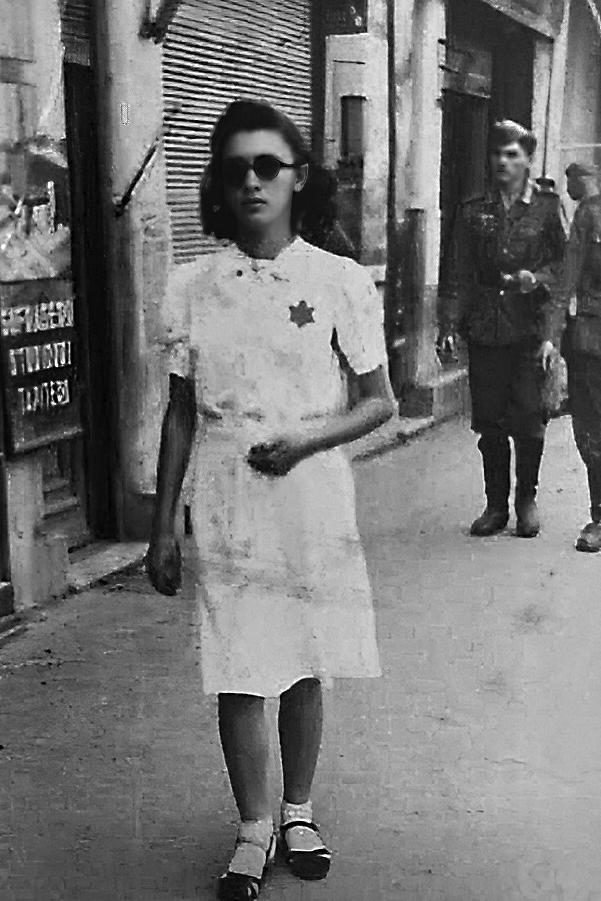
As a young woman, Hannah pursued practical skills suited to the times. She attended a trade school in Romania that trained girls in sewing, clothing design, and related crafts. After graduating, she worked as a model, proudly showcasing the elegant garments she helped create—dresses and outfits made with care and style. A striking photograph from her youth captures this confidence: Hannah walking alone on a street, dressed in a lightly pleated dress falling below the knees, fashionable sunglasses perched on her nose, white socks over black Mary Janes, and a Star of David badge pinned to her lapel. In the background, three German soldiers stand nearby, one gazing directly at her—perhaps the German soldier she once fell in love with, who repeatedly visited her home asking for her, only to be chased away by her protective father.
World War II shattered this world. Romania, allied with Nazi Germany until 1944, saw increasing persecution of Jews, including forced labor, deportations, and violence. When German forces occupied or influenced the area, danger mounted, but the real terror for Hannah and her sisters came after the Germans withdrew and Soviet (Russian) soldiers arrived to occupy the town. The family viewed the Russians as even more threatening—often drunk, unpredictable, and prone to seeking out young women. To protect themselves, Hannah and her five sisters hid in the attic of their family home for an extended period. Their parents, along with the brother and father, brought them food, water, and necessities when it was safe, but the soldiers' constant presence in and around the house made visits risky and infrequent.
Hunger became a constant companion. On one occasion, unable to reach the attic for longer than expected, the sisters grew delirious with starvation. In desperation, they dipped into a large vat of simmering cherries stored in the corner—cherries that had begun fermenting into Wishniak, a traditional cherry liqueur. The accidental intoxication left them drunk and laughing hysterically on the floor by evening. When their parents finally arrived with proper food, they found the six girls in this giddy, chaotic state—a moment of absurd relief amid terror.
Another close call came when word spread of a rampaging soldier searching house-to-house for hidden young women. The sisters quickly submerged themselves deep in giant haystacks piled in the attic. The soldier stabbed at the hay with a pitchfork, piercing one sister's arm and leaving a lasting scar. She bit her tongue to stifle any cry of pain, ensuring the family remained undetected. Survival was never individual heroism but a collective effort—"as a pack," as the family remembered it—relying on silence, quick thinking, and the quiet support of parents risking their own safety.
After the war ended in 1945, Romania's Jewish communities faced continued hardship amid postwar chaos, economic ruin, and lingering antisemitism. Hannah, now a refugee, fled Eastern Europe. She eventually made her way to the newly established State of Israel, where displaced Jews from across Europe sought to rebuild. There, she met Joseph Schoenberger, known as Zeideh to his grandchildren—a survivor from Slovakia who had lost nearly his entire family in the concentration camps, with only his little sister escaping with him. Their marriage was practical and transactional in the postwar reality: he needed a family and stability after unimaginable loss, and she, one of the last unmarried siblings in her own family, needed to settle down and start anew.
Hannah's journey from the attic hiding places of wartime Romania to the promise of Israel marked the end of one chapter of terror and the beginning of a new life built on resilience, family bonds, and quiet strength. She carried the lessons of survival—resourcefulness in crisis, devotion to loved ones, and an impeccable sense of style—into the decades that followed, eventually moving with her husband to the United States, where she became a masterful seamstress, devoted grandmother, and enduring presence until her passing in April 2023.
Escaping the Soviet Gulag
In the late 1930s, as Joseph Stalin's Soviet Union intensified its drive for rapid industrialization through the Second and Third Five-Year Plans (1933–1937 and 1938–1942), millions of workers—often from rural villages like the one where Rachel Michaelson (later Oksman) and her family had resettled after escaping the collective farm—were conscripted into factories to fuel the regime's ambitions. This era, marked by harsh labor decrees that criminalized absenteeism or job changes as acts of sabotage, saw countless families torn apart by the state's relentless demands. Rachel's father, having rejoined the family in their modest village home in the Gomel region of Belarus, was soon assigned to grueling work at a nearby town's factory, typical of the heavy industry hubs sprouting across the Belarusian SSR to produce machinery, metals, and armaments.
Tragedy struck when, amid the hazardous conditions prevalent in these under-equipped factories—where safety was secondary to meeting impossible quotas—Rachel's father suffered a severe injury, injuring him in one eye. Unable to endure the remote labor any longer, he returned home around 1938 or 1939, hoping to recover with the care of his wife and children, including the resourceful teenage Rachel, now in her mid-teens. But the Soviet system, with its labyrinthine bureaucracy and overlapping authorities, offered little mercy for such personal hardships. Desperate to prevent further separation, Rachel boldly approached the local Communist Party office, a key enforcer of central policies in every village and town. There, she pleaded for officials to reassign her father to lighter, local duties so the family could tend to him. Surprisingly, her earnest appeal succeeded; the officials, perhaps recognizing the inefficiency of sending an injured worker away, issued paperwork approving the transfer.
Yet, in the fragmented Soviet administrative machine—where communications between distant factories, party offices, and security organs often lagged or failed entirely—the remote factory was never notified. When Rachel's father did not report back, he was branded a deserter under the strict labor laws of 1940, which equated such "offenses" with treasonous acts warranting severe punishment. Authorities arrested him without delay, and he was herded onto a crowded freight train bound for the Gulag—a sprawling network of forced labor camps that, from its expansion in the early 1930s through Stalin's death in 1953, imprisoned an estimated 18 million people across the USSR. Conditions in these camps were brutal: prisoners endured starvation, disease, exhaustion from backbreaking work in remote Siberian mines or Arctic timber operations, and arbitrary executions, leading to an estimated 1.5 to 1.7 million deaths in the camps alone between 1930 and 1953, with peaks during the famine-stricken war years of 1941–1943 when mortality rates soared. This system, which had ballooned during the Great Purge of 1936–1938 when hundreds of thousands were executed or dispatched to the camps on fabricated charges, represented the ultimate terror for ordinary Soviet citizens like Rachel's family.
Refusing to let bureaucracy doom her father, Rachel—armed with the original transfer documents from the party office—stationed herself defiantly in front of the local courthouse, a hub of judicial and administrative power in the region. Her persistence paid off when a guard, perhaps intrigued by the determined young woman's presence, inquired about her issue and escorted her to the local judge. Presenting the paperwork, Rachel explained the clerical error with urgency, highlighting how it threatened to send an innocent, injured man to his likely death in the far-flung camps.
The judge, seeing the validity of her claim, coordinated with the Communist Party officials to intervene. By then, Rachel's father was well underway on the train, enduring the dehumanizing conditions of transport in sealed cattle cars, where prisoners often faced days without food or water. In a stroke of rare fortune amid the era's pervasive fear, the authorities transmitted an urgent message—likely via telegraph to intervening stations or guards—broadcasting over the train's rudimentary speakers or through direct orders: "Michaelson, you may get off." The command reached the transport in time, allowing Rachel's father to disembark at a stop and return home, spared from the Gulag's deadly grip.
This harrowing episode, unfolding against the backdrop of Stalin's repressive policies that ensnared millions in a web of forced labor and arbitrary justice, underscores Rachel's unyielding courage. It turned a potential family tragedy into a testament to human resilience, even as the broader Soviet society grappled with the shadows of industrialization, purges, and the ever-present threat of the camps.
An Arranged Union, the Grain Heist, Bribery, and Flight to Israel
(late 1940s–1970s)
After World War II devastated Eastern Europe and the Holocaust claimed millions—including Jacob Oksman's entire family in Rivne, Poland (now Ukraine)—Rachel's parents arranged her marriage to Jacob for security in the chaotic postwar years. Jacob, who had fled the Nazis at seventeen on a bicycle and survived as the lone member of his family, arrived in the Gomel region under Soviet control. Their meeting in the late 1940s was not romantic but pragmatic: an arranged union common among displaced Jews seeking stability amid poverty and rebuilding.
On their wedding night, the terrified teenage Rachel—barely knowing her older husband—challenged him to a vodka-drinking contest to delay intimacy. She secretly ate butter to line her stomach and excused herself to vomit, staying composed while asserting a rare moment of control. Later she revealed a poignant regret: as a teenager she had loved a poor young man who went to the army and wrote begging her to wait, but her mother hid the letters and only showed them after the marriage was arranged.
Rachel and Jacob soon found work together in a state-run flour or grain processing factory in the Gomel region. Rachel worked as a bookkeeper or administrator, managing records in a system plagued by chronic shortages. The Soviet famine of 1946–1947, triggered by drought, war damage, and heavy state requisitions, intensified black-market activity as official supplies failed to meet demand.
In the early 1950s, Rachel and Jacob organized a small heist: one night they siphoned off excess flour or grain and sold it to locals on the black market—a widespread survival tactic in an economy of scarcity. When Jacob was caught, facing arrest in a judicial system riddled with corruption, Rachel drew on her earlier experience navigating Soviet bureaucracy. She took a significant sum from the heist proceeds—equivalent to about $10,000 in today's money—and went to the home of the female judge she had known since pleading for her father's release years earlier.
Arriving nervously, Rachel found a Russian general or commander in uniform present, heightening her fear in an era when military and civilian authority intertwined. The judge led her to the kitchen for a private negotiation. There, they struck a deal, and Jacob was released the very next day.
This success turned Rachel into the town's unofficial "fixer" through the 1950s and 1960s. Families with arrested relatives sought her out, hoping she could arrange bribes for their release in a corrupt system where such practices had become an unspoken art of survival.
Rachel continued this role for years, but rising antisemitism, personal risks, and the desire for a freer life prompted her and Jacob to flee the Soviet Union for Israel in the 1970s. This was during a major wave of Jewish emigration (over 150,000 left between 1970 and 1979), fueled by discrimination, international pressure, and the refusenik movement. When Rachel informed the judge of their departure, the woman expressed deep disappointment, saying she had "never been so well off" from the lucrative bribes.
